How to Buy Parts in Cofactr: Carts, Checkout, Lead Times, and RFQs
Last updated: November 18, 2026
This guide covers everything you need to buy parts in Cofactr, whether you're ordering a single part, from a BOM, or from a Program.
In this article:
Add parts to a cart
Check out your cart (including choosing your lead time)
Request quotes (RFQs)
Approve or reject a quote
Track your order
1. Add Parts to a Cart
Option A: A single part (from the Parts page)
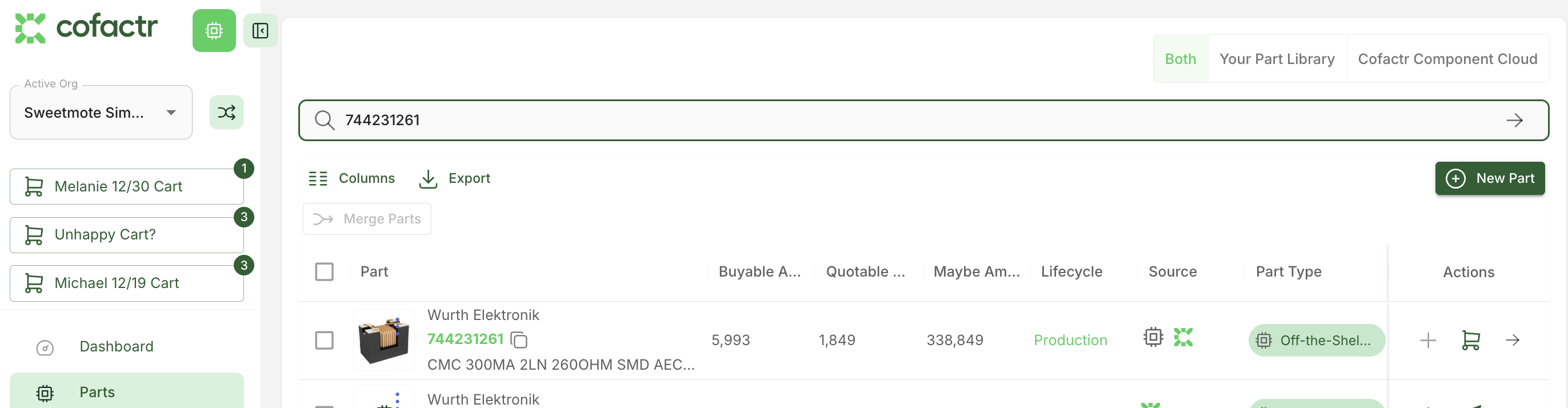
Go to Parts in the left sidebar and search for your part. Searching under Both checks your org's part library and the Cofactr Component Cloud at the same time.
Click the shopping cart icon under Actions. You can also do this from the part detail page if you want to review specs first.
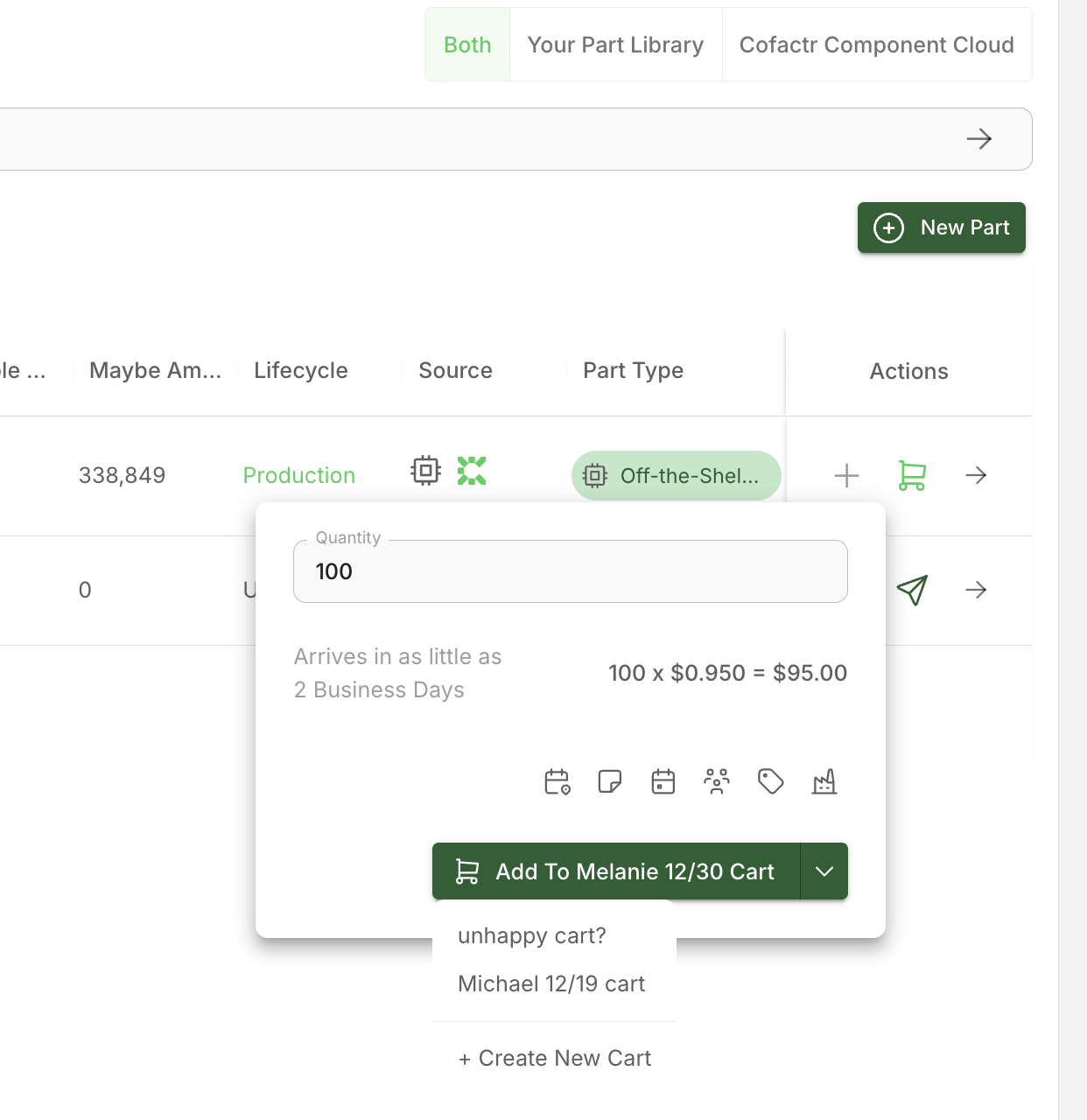
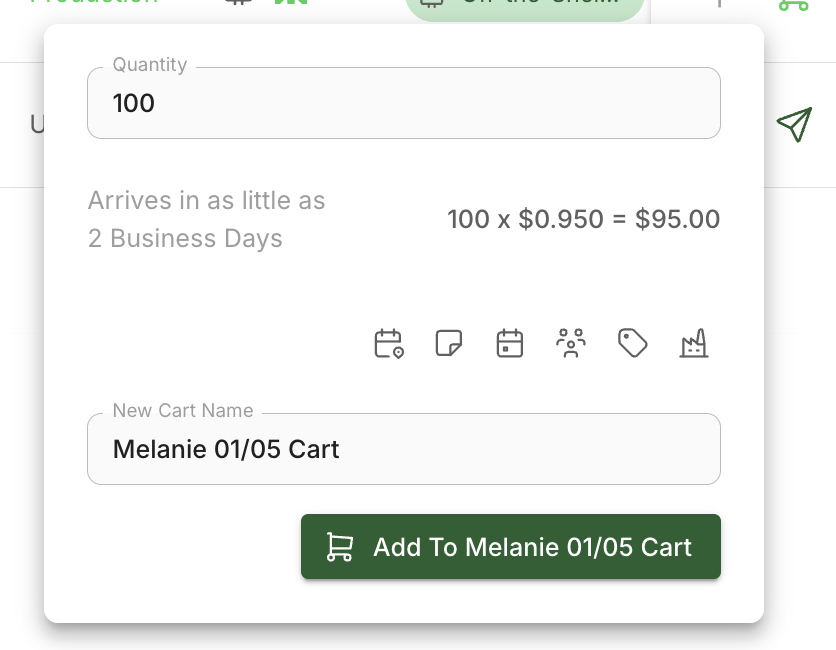
Enter your quantity and choose an existing cart, or select + Create New Cart and give it a name.
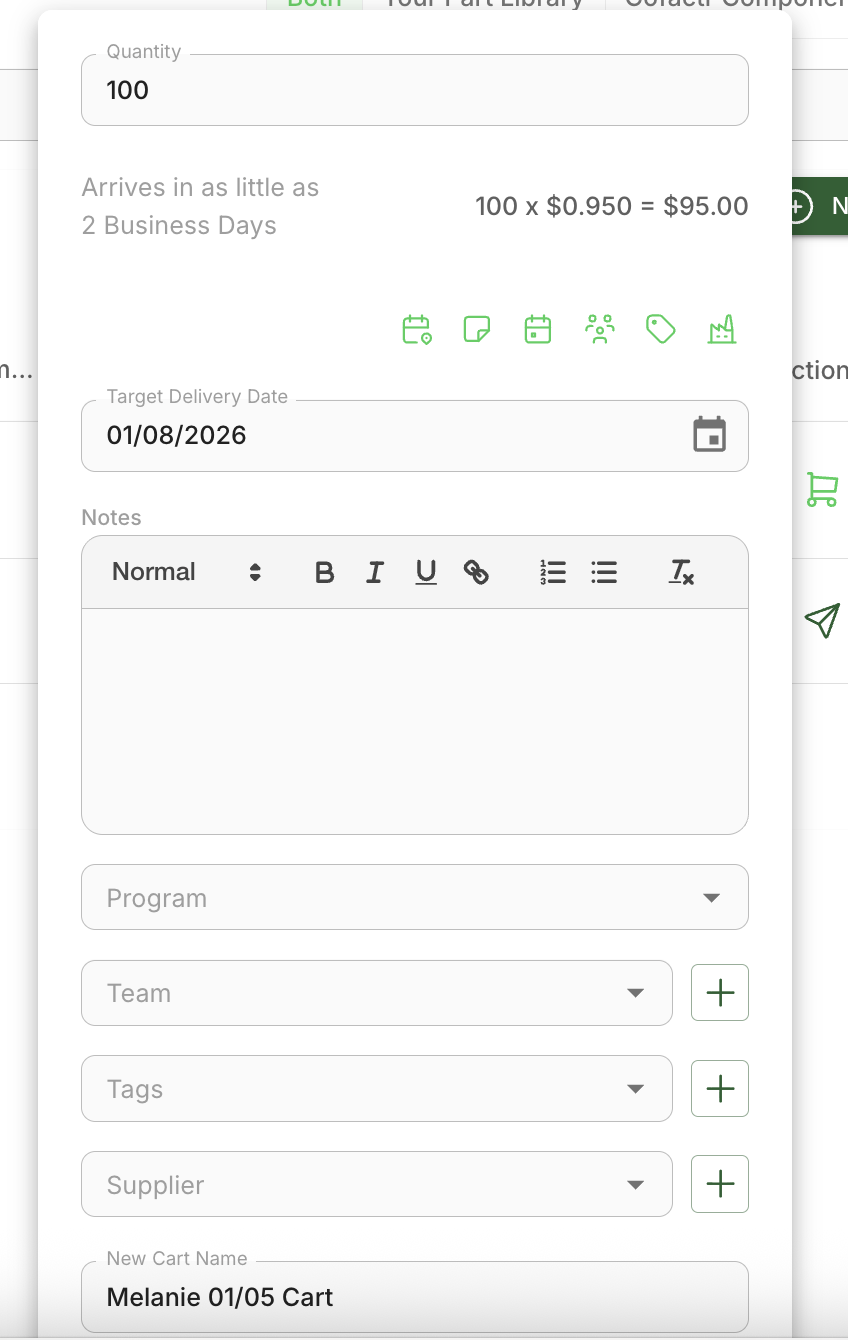
Optional: use the icons to add a Target Delivery Date, Notes, Program, Team, Tags, or Suppliers. For example, select a Program to allocate the parts to it.
Option B: From a BOM or Program
Open your BOM or Program, select the parts you want, and click Add to Cart.
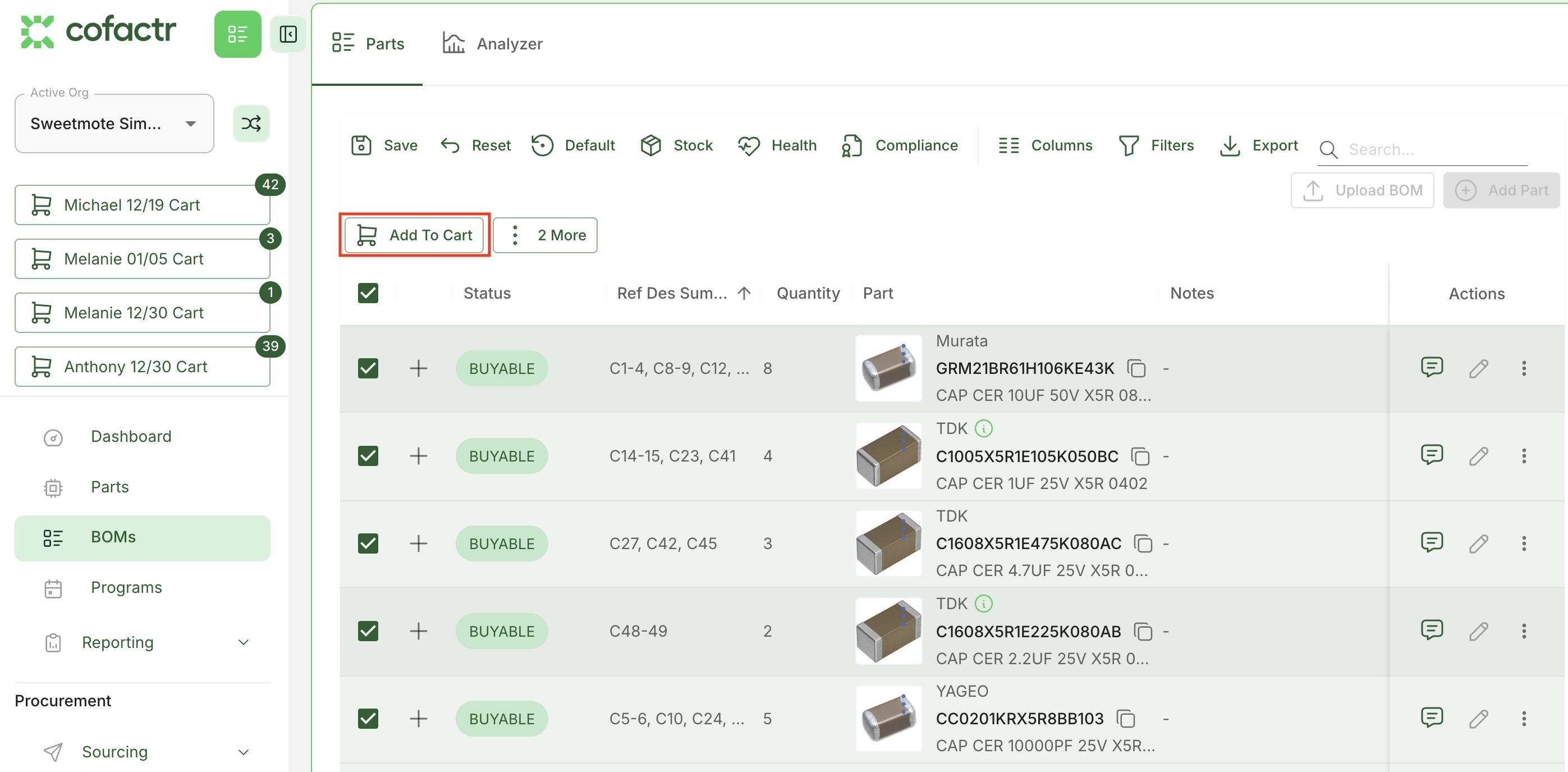
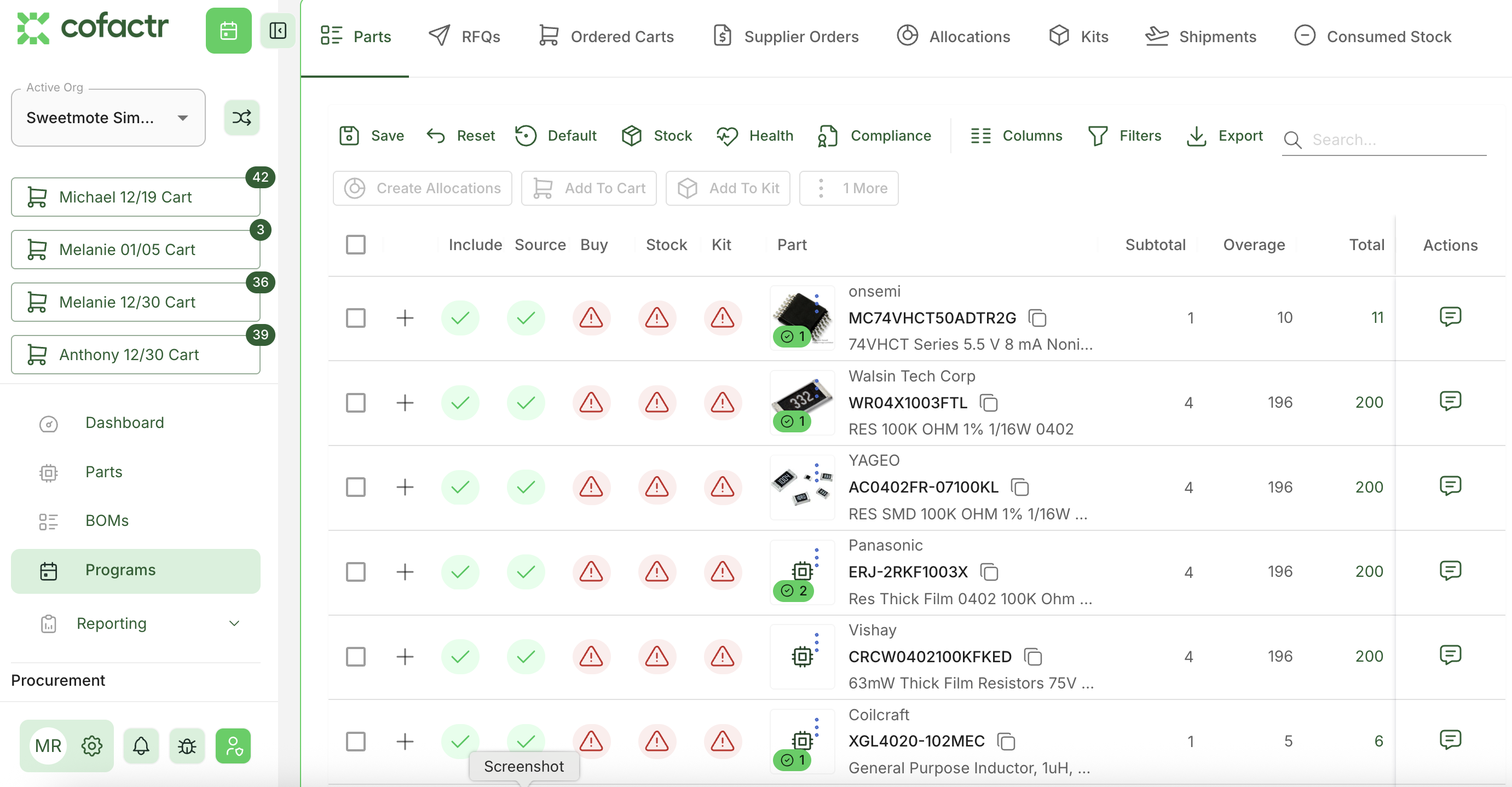
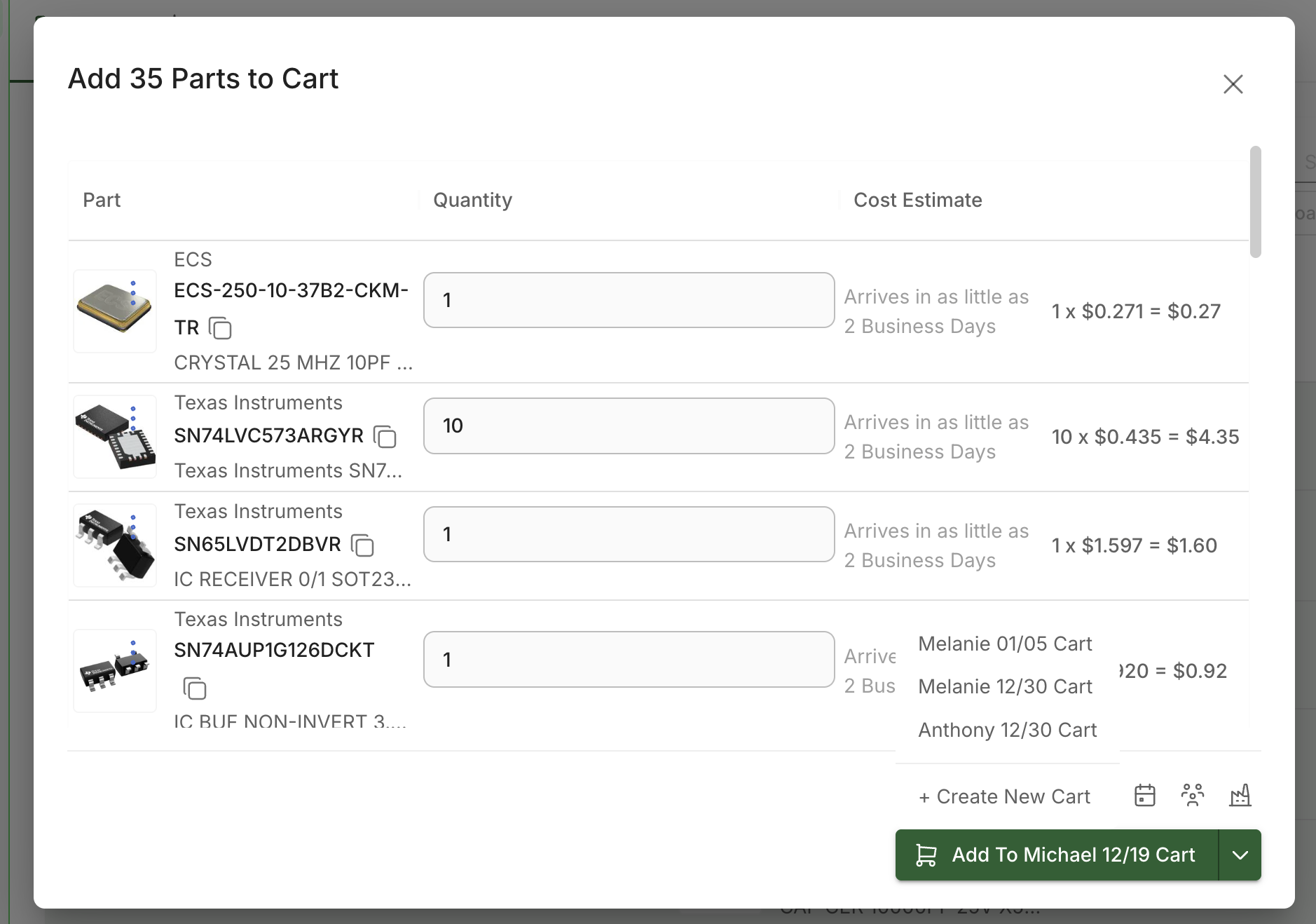
Adjust quantities if needed, and toggle on RefDes or BOM Line Numbers if you want them printed on your labels.
Add the parts to a new cart, or pick an open cart from the dropdown.
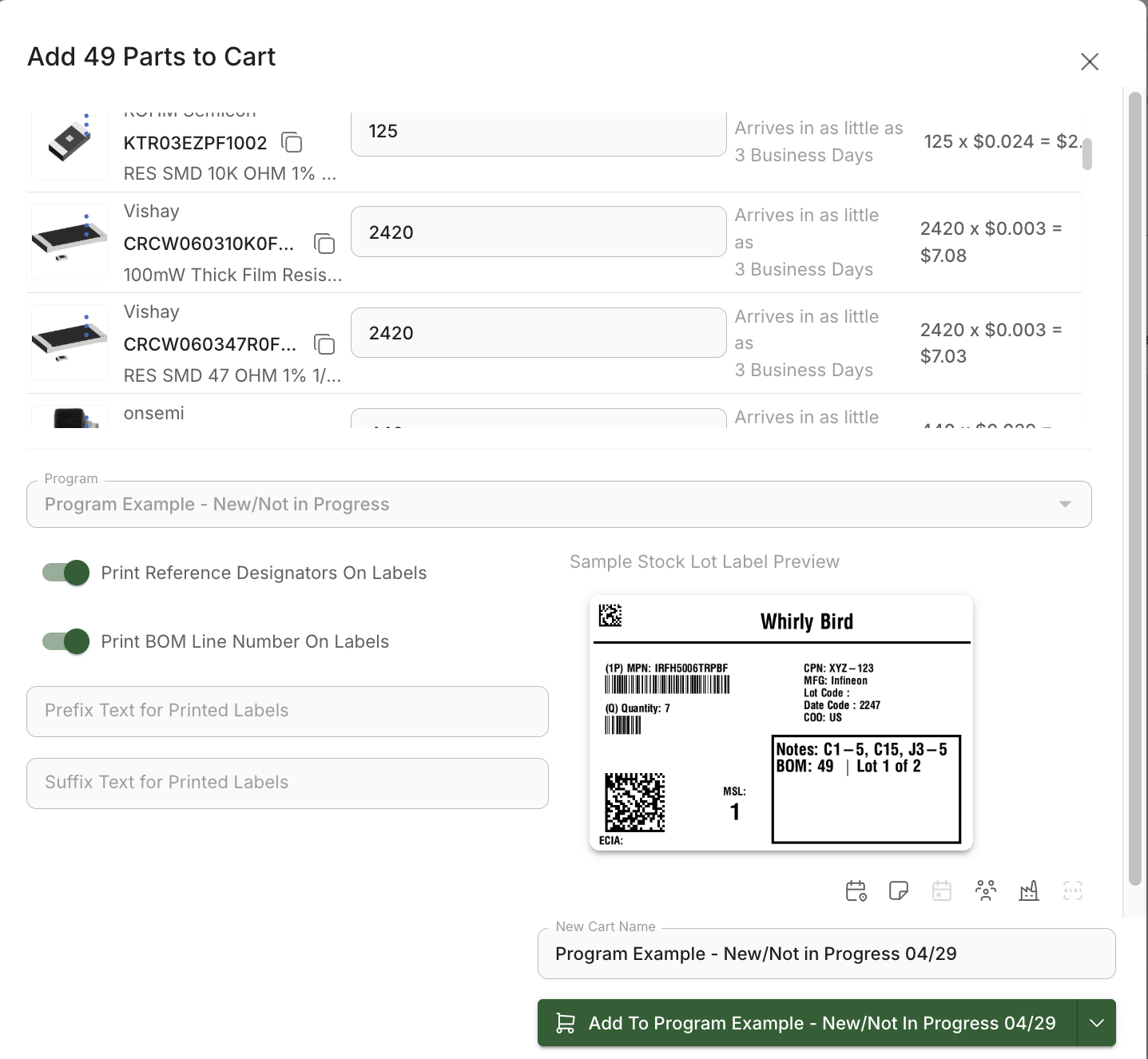
Program vs. BOM purchases: Parts bought through a Program are linked to that Program and automatically allocated when they arrive at our warehouse. Parts bought from a BOM or as a Spot Buy arrive without allocations, so other users in your org can use that inventory.
2. Check Out Your Cart
Your cart appears in the upper left corner of the platform. Hover over it to see each part, quantity, estimated unit price, and estimated total.
Click Edit Cart or Checkout.
Review your parts. Parts that are ready to buy are listed separately from parts that need a supplier quote (see section 3 for RFQs).
Choose your shipping option.
Shipping options
Store at Cofactr: Parts are added to your inventory and stored at your selected Cofactr warehouse.
Ship as a Kit: Parts are checked, labeled, and kitted together at one of our warehouses, then shipped as one package.
Drop Ship: Parts ship directly from suppliers to your destination.
Choose your lead time. Don't skip this step. The lead time you pick decides which supplier we buy each part from, how fast it ships, and what it costs. Choose a specific lead time or ASAP.
When you select a specific lead time
For each part, we choose the lowest-cost compliant supplier that can meet the lead time you selected.
We order everything right away and don't hold any parts back to match the longest lead time. Some parts will still arrive early because the lowest-cost supplier happens to be fast.
If a part is available in 3 days at a higher price but a cheaper supplier fits your lead time, we'll buy from the cheaper supplier, and that part will take longer to arrive.
When you select ASAP
We order each part from the fastest available supplier, using the fastest shipping that supplier offers.
Each line gets its own estimated delivery date, based on that part's lead time at checkout. Parts that are in stock come in quickly, and long lead time parts still take as long as their lead time.
ASAP usually costs more than a set lead time, because the fastest supplier and shipping option often aren't the cheapest.
We can only use the shipping options each supplier offers, so the fastest option isn't always overnight.
ASAP doesn't speed up long lead time parts. It gets each part as fast as the market allows, but a part with a 30-week lead time will still take about 30 weeks. If you need parts sooner than their listed lead time:
Choose the lead time that matches when you actually need the parts.
Submit an RFQ for the long lead time parts so our procurement team can look for faster sources (see section 3).
Add your need-by date in the cart or RFQ notes so we know your deadline.
Optional: add a PO number to bill against.
Under Submit Order, click Accept Terms and Conditions and approve your order.
Carts can be public or private. Learn more about shared carts.
Video walkthrough: Cart checkout
3. Request Quotes (RFQs)
If a part needs a supplier quote, or you want our procurement team to find a better price or lead time, submit an RFQ. Once submitted, our procurement team goes out and finds you the best quote available.
From a Program (most common)
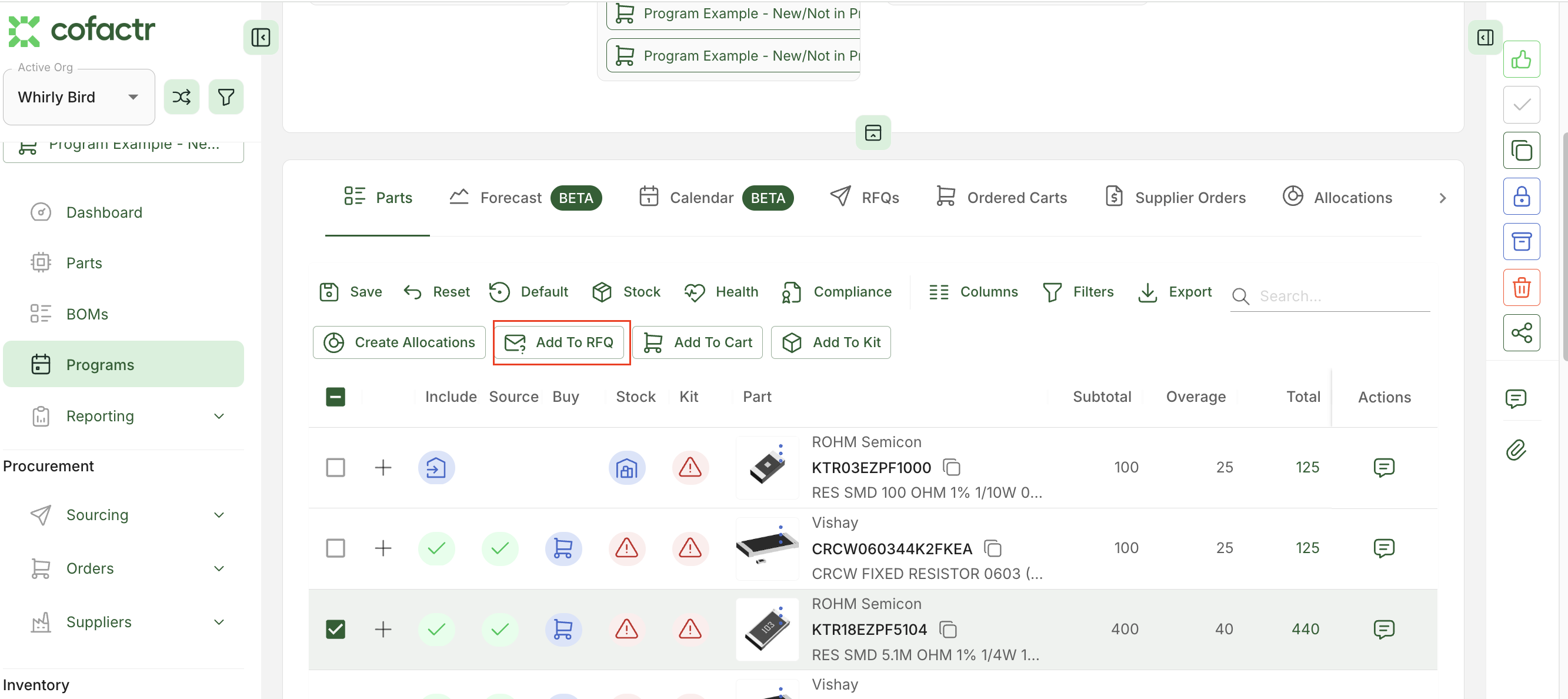
In your Program, select the parts you need quotes for and click Add to RFQ.
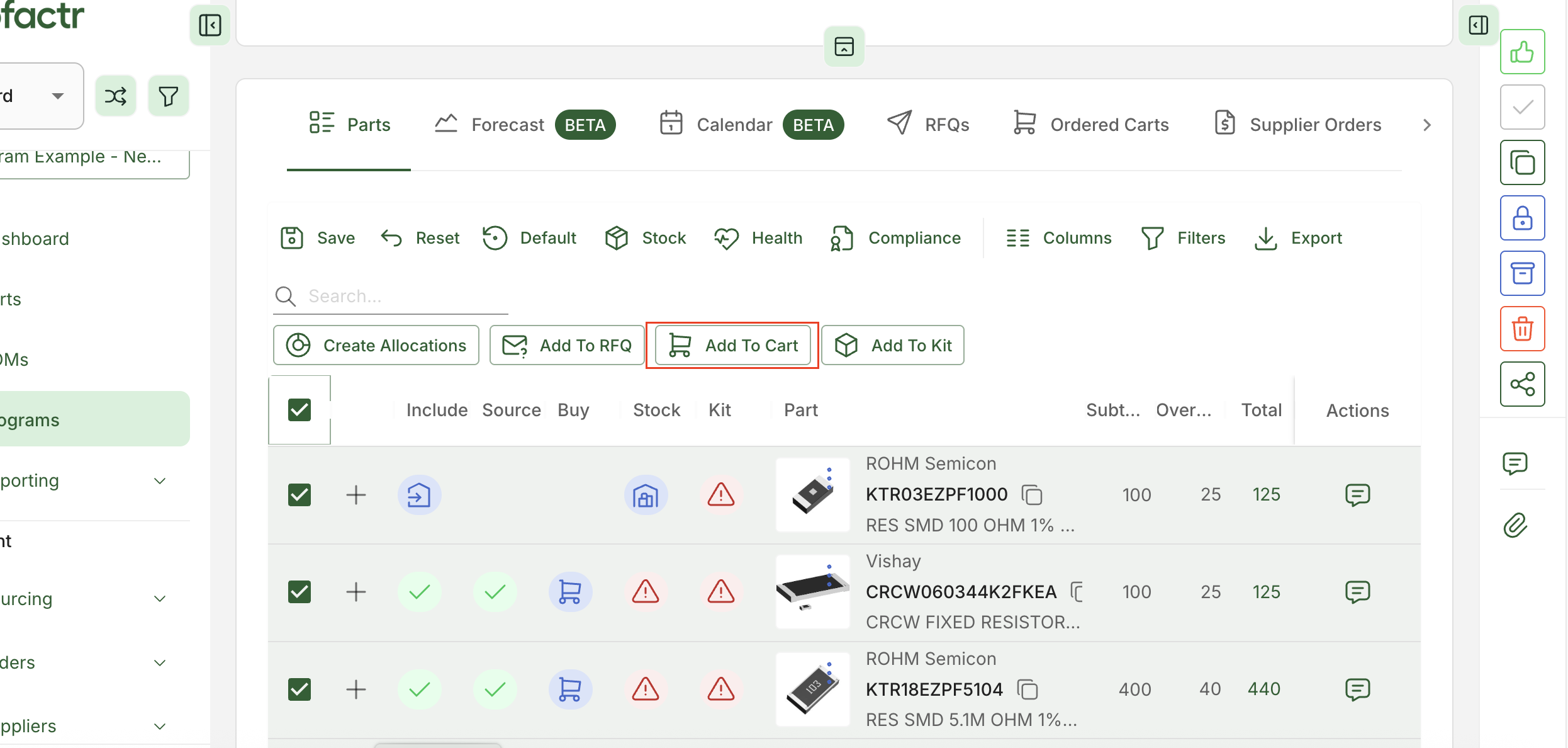
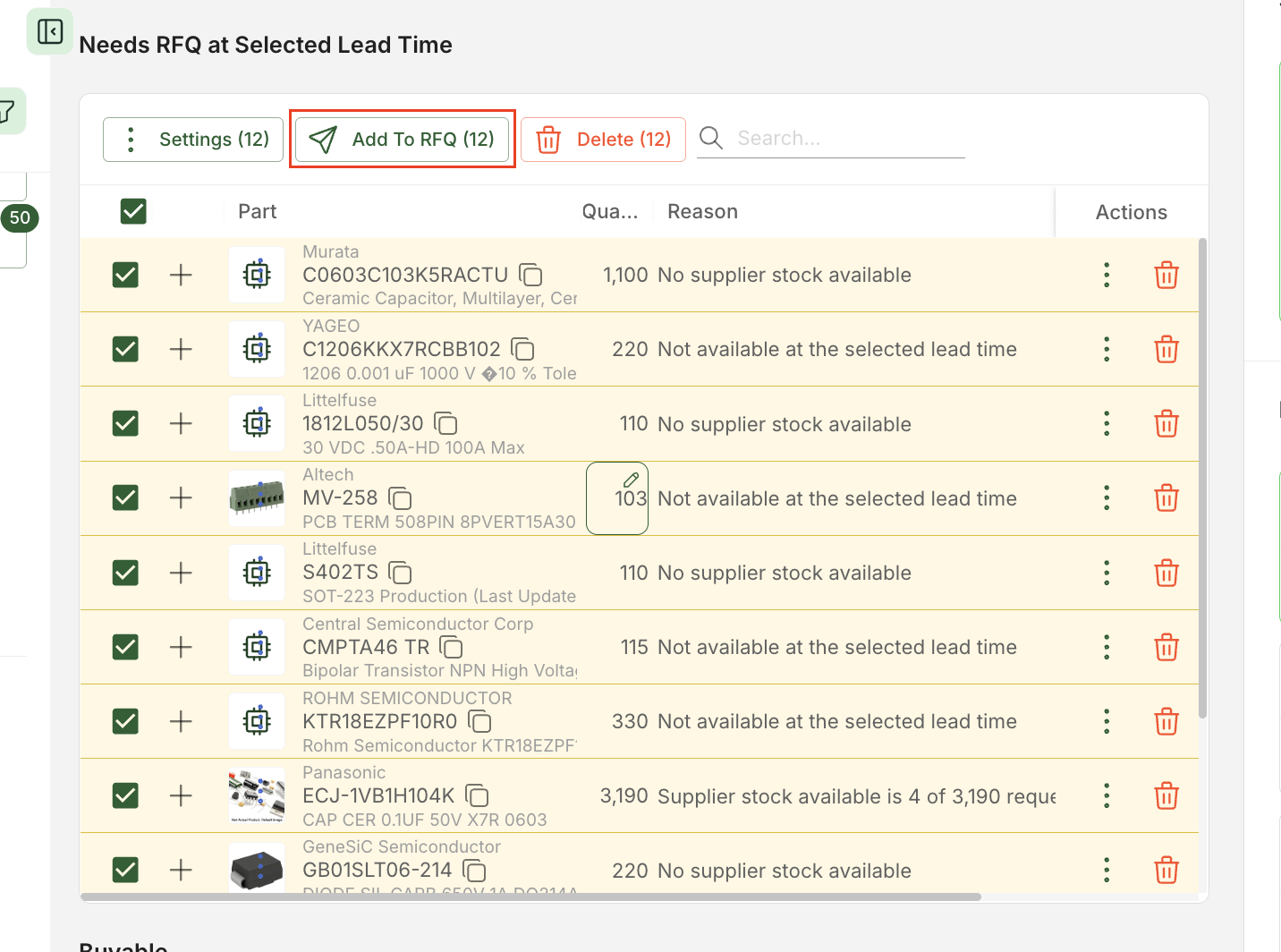
Tip: To buy everything that's ready and quote the rest in one pass, select all lines in your Program and click Add to Cart. In the cart, the yellow section at the top shows parts that need an RFQ. Select those parts and click Add to RFQ.
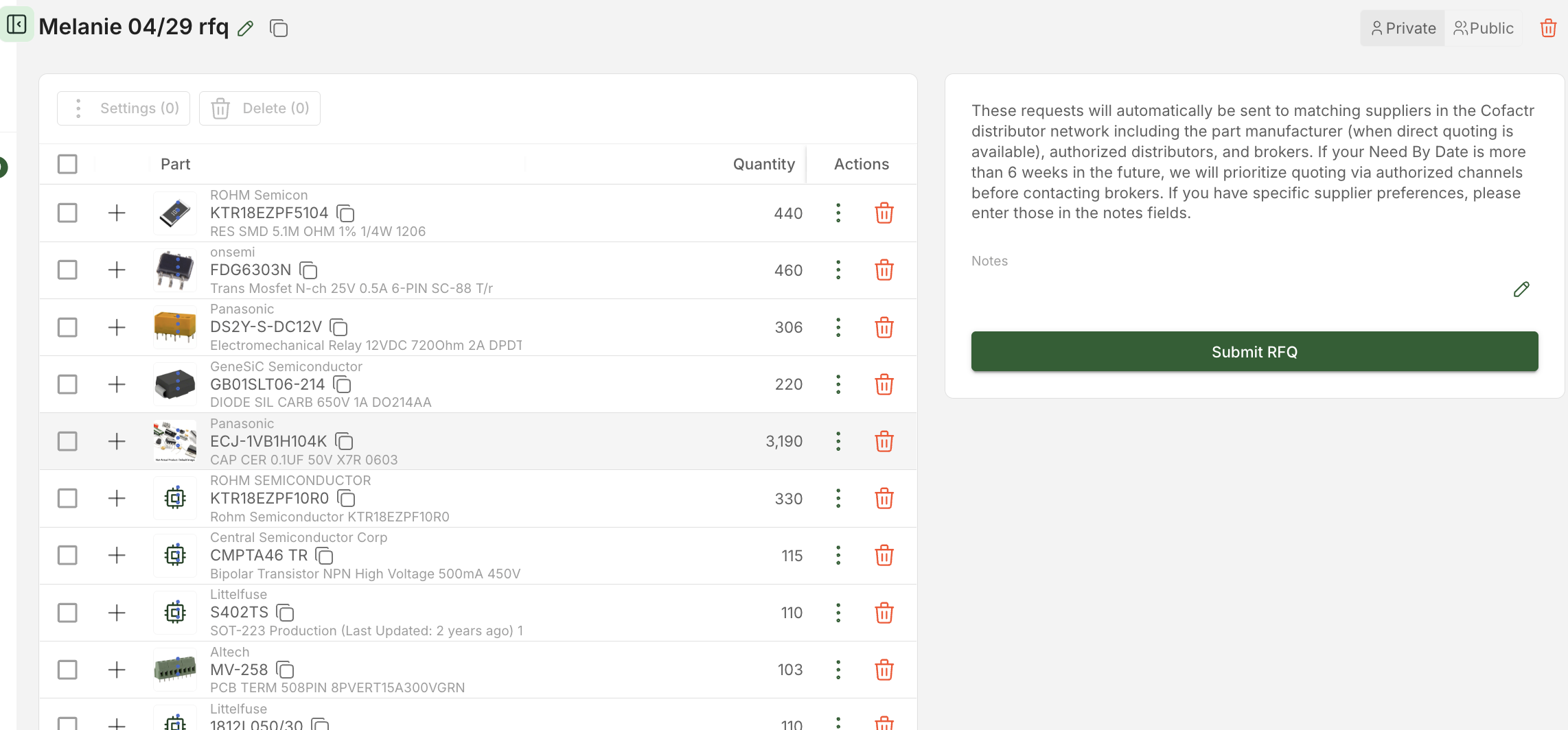
Add any notes you want our team to know, then click Submit RFQ.
For a single part
Go to Parts and search for the part. Then either:
Click the paper plane icon in the Actions column, or
Open the part detail page and click Add to RFQ in the upper right corner.
Enter your quantity and create a new RFQ or add to an existing one. The same optional fields from the cart (Target Delivery Date, Notes, Program, and so on) are available here.
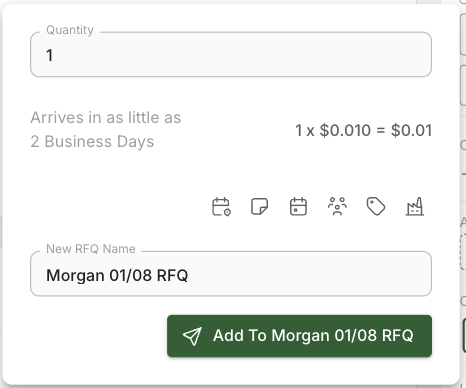
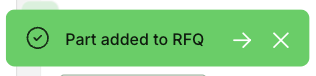
Name your RFQ and click Add to [RFQ Name]. Your RFQ shows up in the upper left sidebar, or you can open it from the green confirmation pop-up.
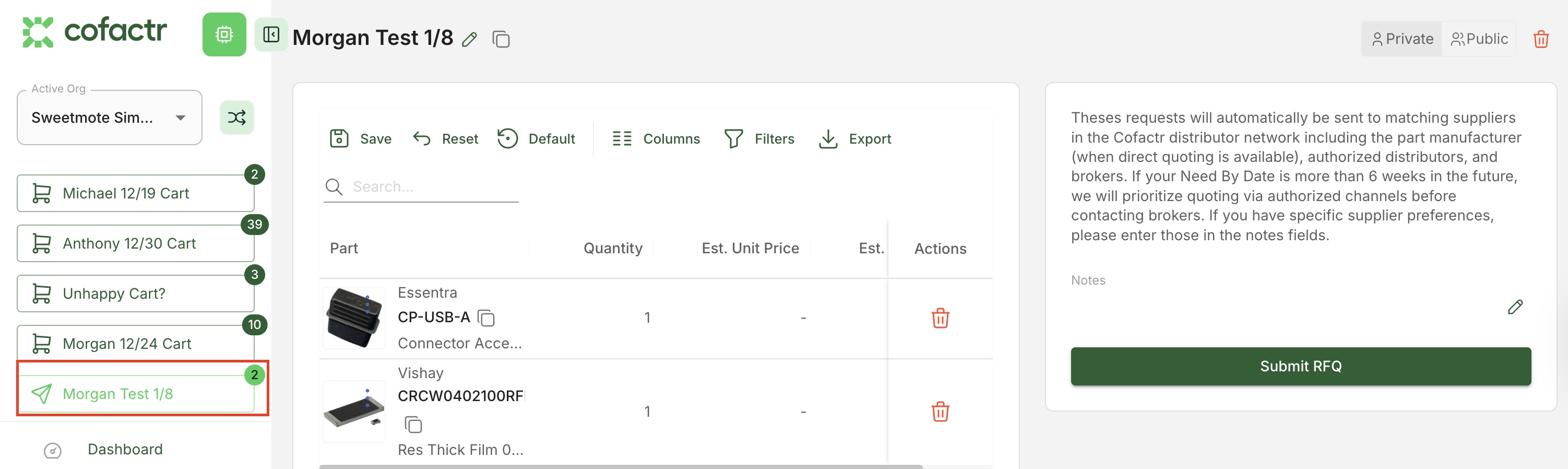
Open the RFQ, review the parts, and click Submit RFQ.
Video walkthroughs: Single-part RFQ
Paper plane icon in the Actions column
Add to RFQ from the part detail page
4. Approve or Reject a Quote
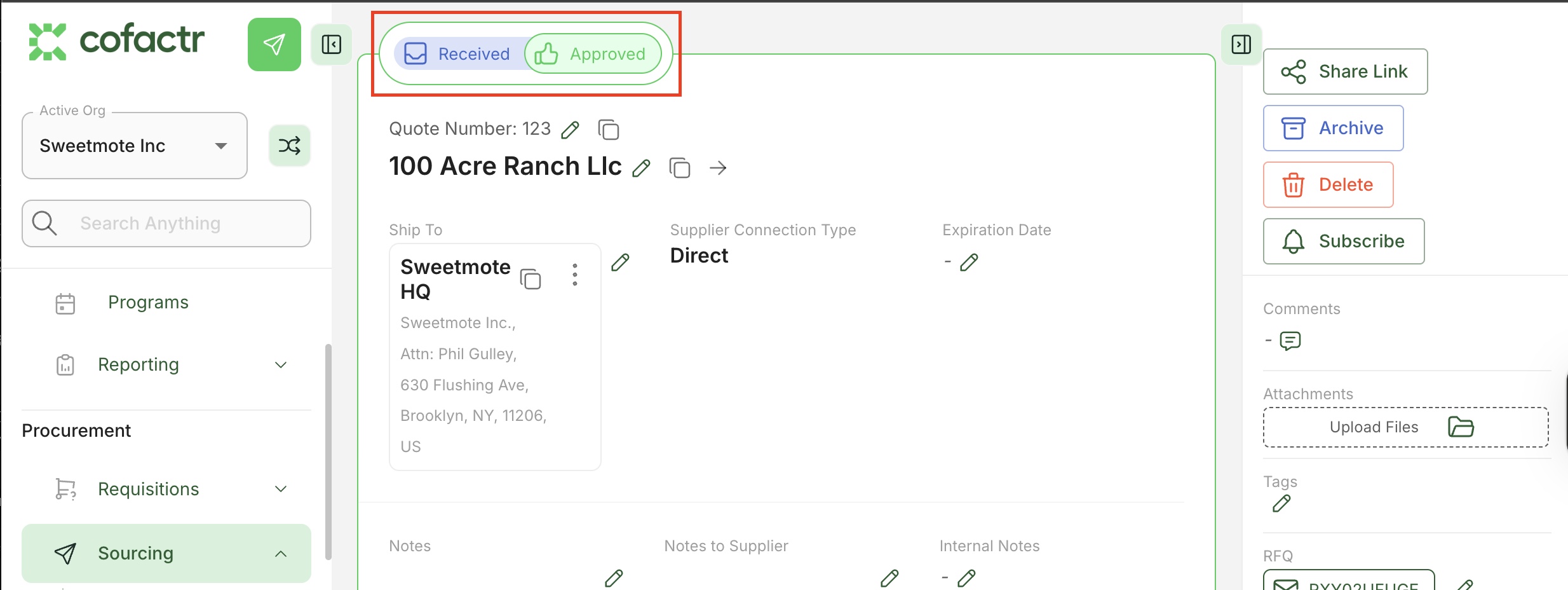
When suppliers send quotes back, find them under Sourcing → Supplier Quotes.
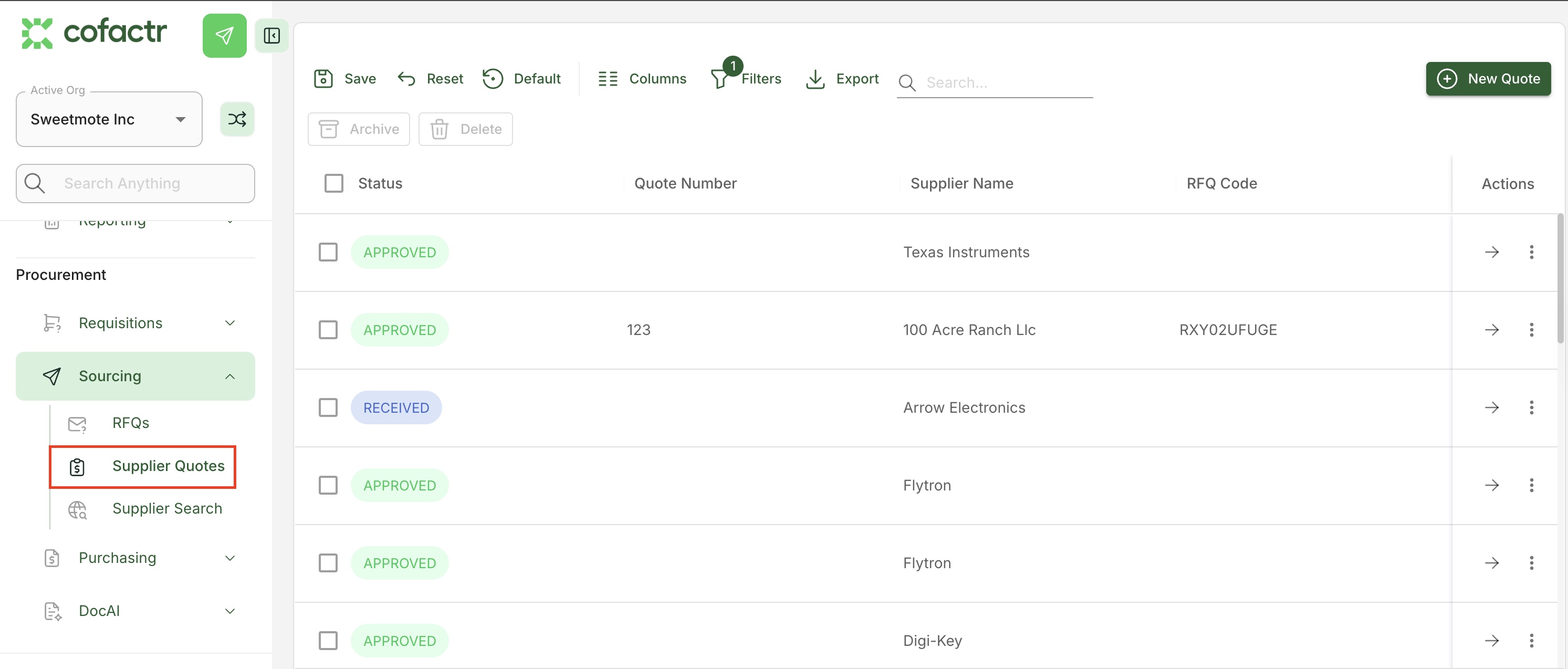
Click the RFQ line item you want to approve or reject.
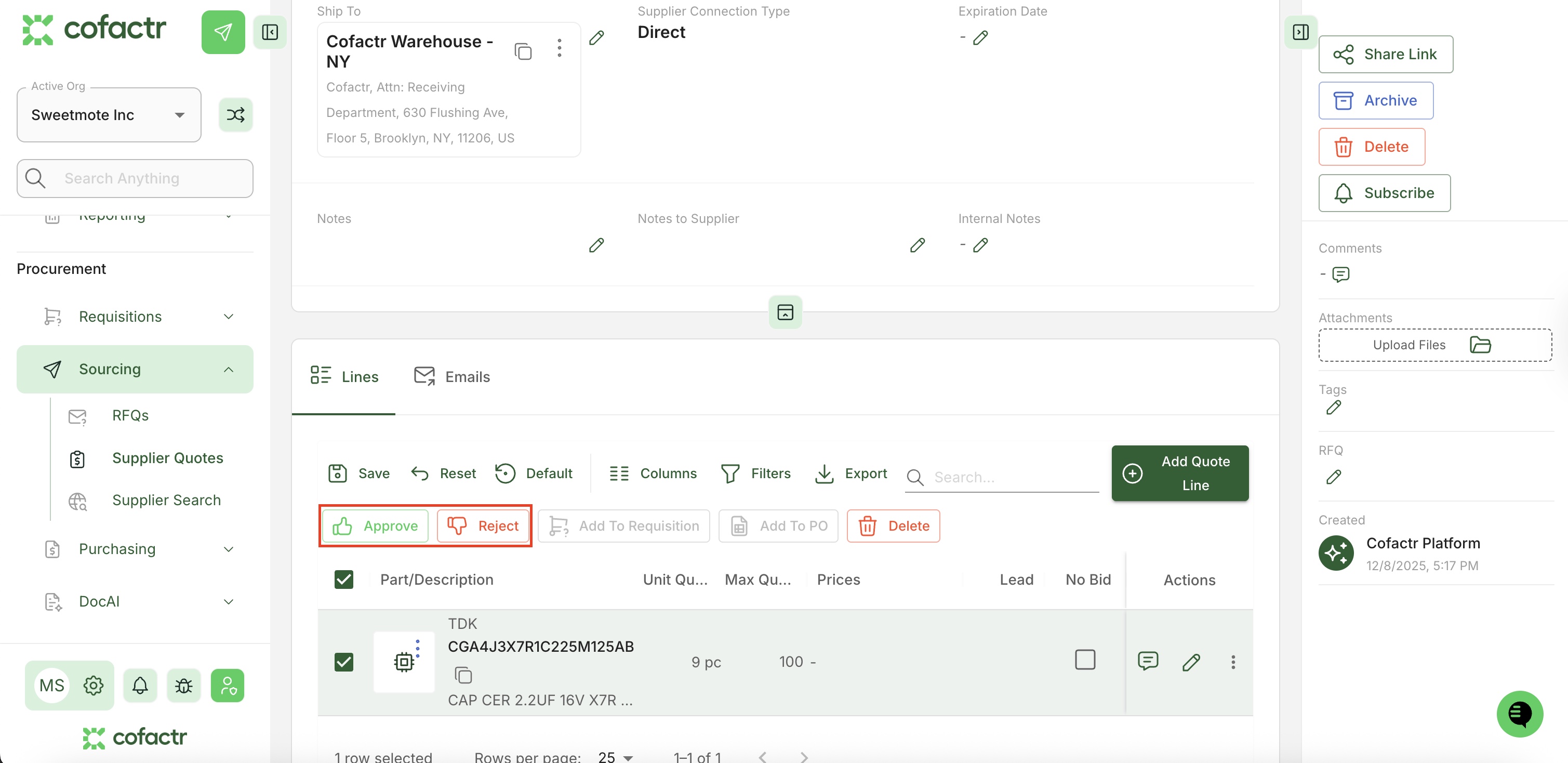
Approve: Order from your open cart or BOM/Program, or click the cart icon on the quote to place the order (see section 2).
Reject: The quote shows as Rejected on your Supplier Quotes page, and you won't purchase against it.
5. Track Your Order
After you place an order, you can check its status in two places:
Ordered Carts: the status of the whole cart, including all supplier orders.
Supplier Orders: the status of each supplier order within the cart.
Still have questions? Reach out to success@cofactr.com or use the in-app chat.
Written By: Melanie Reeves and Morgan Seeton